
22 de setembro de 2026



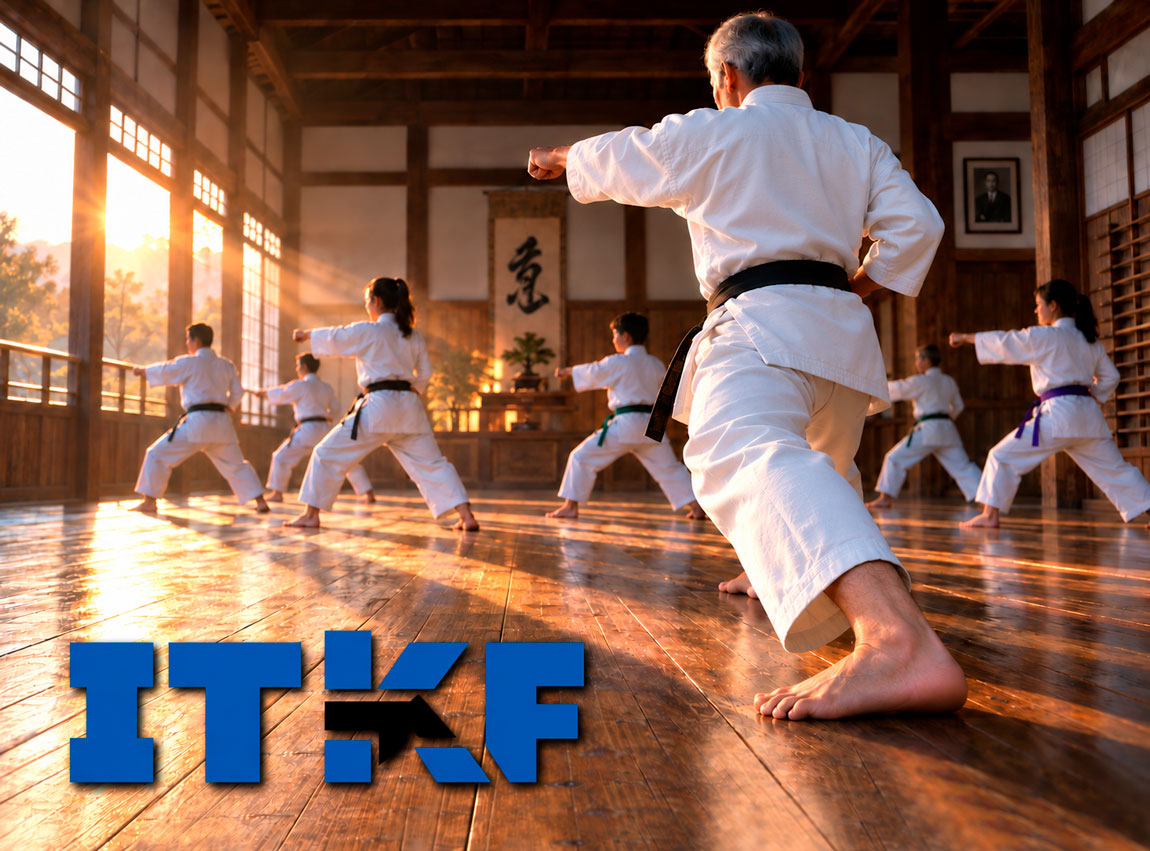 The strength of Budō lies in the practitioners who keep the tradition alive and make respect, discipline and learning a lifelong commitment © Global Esportes / AI-generated illustrative image
For many years, the ITKF sought Olympic recognition. We did not achieve it. At the time, it felt like a defeat. Today, looking back, perhaps we should ask a different question: what if that defeat was precisely what allowed us to survive as an institution and preserve the essence of traditional karate?
The problem was never joining a major sports organization. The problem begins when belonging to it requires us to change who we are.
The modern Olympic system demands sports that are increasingly easy for large audiences to understand, suited to television, entertainment and the demands of spectacle. Had we entered that system and, over the years, adapted our rules, technical concepts and philosophy to those demands, how much of traditional karate would have survived? How much of Budō would remain?
Perhaps what we regarded for years as a defeat was, in fact, what protected us.
Our Constitution states unequivocally: “Victory, in itself, is not the ultimate goal of traditional karate.”
In the traditional concept of shi-ai, two practitioners do not meet simply to determine who is superior. They test one another and, through that encounter, discover what they still need to develop.
We want to win. Naturally. But a medal cannot matter more than what we learn along the way. We often learn more from losing than from winning.
This is where an essential difference between spectacle and Budō emerges. In major professional sports, thousands of spectators gather to watch a small number of athletes compete. In traditional karate, the opposite is often true: we have more practitioners than spectators.
This is not a sign of weakness. It is one of our greatest strengths. It means our community does not exist primarily to watch karate. It exists to practise it.
Our worth is not measured by the size of the stands. It lies in the people who enter the dojo, put on their karate-gi, repeat a technique thousands of times, make mistakes, correct them, learn, grow older and keep training.
Sport as a major spectacle needs an audience. Budō needs practitioners.
In The New Lords of the Rings, Andrew Jennings showed how the vast world of international sport can also be tainted by power, vanity, financial interests and corruption.
Traditional karate chose a different path. Not because we are better, but because our purpose is different.
We want people to practise karate, not merely consume it. People who find in Budō a means of facing the impermanence that defines our lives: victories and defeats, youth and ageing, health and illness, moments of strength and those when we must begin again.
Perhaps this is one of the greatest treasures we still have to preserve.
Without the resources of the Olympic system, the ITKF is sustained by the voluntary work of its leadership, Technical Committee members, referees and other contributors. No member of the ITKF administration receives a salary for serving the federation. Our funding comes primarily from nearly 40 affiliated countries that are fully up to date with their obligations to the ITKF.
This is not simply an administrative statistic. Each annual membership fee paid represents instructors teaching after a full day at work, national officials volunteering hours of their lives, athletes paying for training and travel, small dojos keeping their doors open, and families making sacrifices so their children can continue practising karate.

This money does not come from major commercial contracts. It comes from our practitioners. It comes from work. Often, quite literally, it comes from sweat.
That is why each of these nearly 40 countries deserves our recognition and gratitude. They sustain our independence. They enable us to maintain our website and our technical and administrative structure, protect the ITKF brand, and ensure the federation’s institutional presence wherever it is needed.
These same funds pay for a professional accounting firm in Brazil, where the ITKF is legally based, ensuring that our accounts remain fully up to date and that all our legal, tax and administrative obligations are met.
This may seem elementary. But our recent history has shown that even the basics require competence, discipline and responsibility. We have a moral obligation to respect every dollar we receive because we know where it came from. Managing it properly is also a way of honouring those who earned it.
In a few weeks, we will gather in Cairo for the 23rd ITKF World Championship. We want outstanding techniques, outstanding performances and outstanding champions. But we must arrive in Cairo mindful of what our own Constitution teaches us.
Football is an enormous global industry. It has professional referees, cameras covering virtually every angle, video review and some of the most sophisticated technology available in world sport. Yet we continue to witness arguments, complaints, confrontations between athletes and pressure on referees that often overshadow the game itself.
In Cairo, we cannot allow a medal to become more important than the principles that brought us this far.
Our referees are volunteers. Many travel great distances at their own expense. In a sense, they “pay” for the privilege and responsibility of serving traditional karate.
They may make mistakes. They are human. Coaches may disagree. Officials may feel frustrated. Athletes may lose. But none of this justifies aggression, undue pressure, petty disputes or any behaviour incompatible with Budō.
If we say that victory is not our ultimate goal, we must demonstrate it precisely when victory eludes us.
Let our leaders set the example. Let our coaches teach through their conduct as well. Let our referees be respected. Let our athletes know how to win. And, above all, let them know how to lose.
A moment on the podium lasts only a few minutes. What we learn in the dojo through constant practice can stay with us for a lifetime.
For many years, we wanted to enter the world of the Lords of the Rings. We did not succeed. Today, perhaps we should be grateful for that. Because that defeat may have allowed us to remain who we are: an independent federation built on fellowship, sustained by its own practitioners and grounded in friendship, respect and responsibility.
Perhaps our greatest triumph has been to preserve a community of people who practise, sweat, make mistakes, learn and grow, rather than turn traditional karate into yet another media spectacle intended primarily to be watched.
The spectacle ends when the lights go out. Budō continues the next morning, when someone enters the dojo once again and begins to train. That is why we need practitioners.
A warm welcome to Cairo to you all. We will meet on the tatami.
OSS!
22 de setembro de 2026
21 de setembro de 2026
21 de setembro de 2026