
14 de outubro de 2026




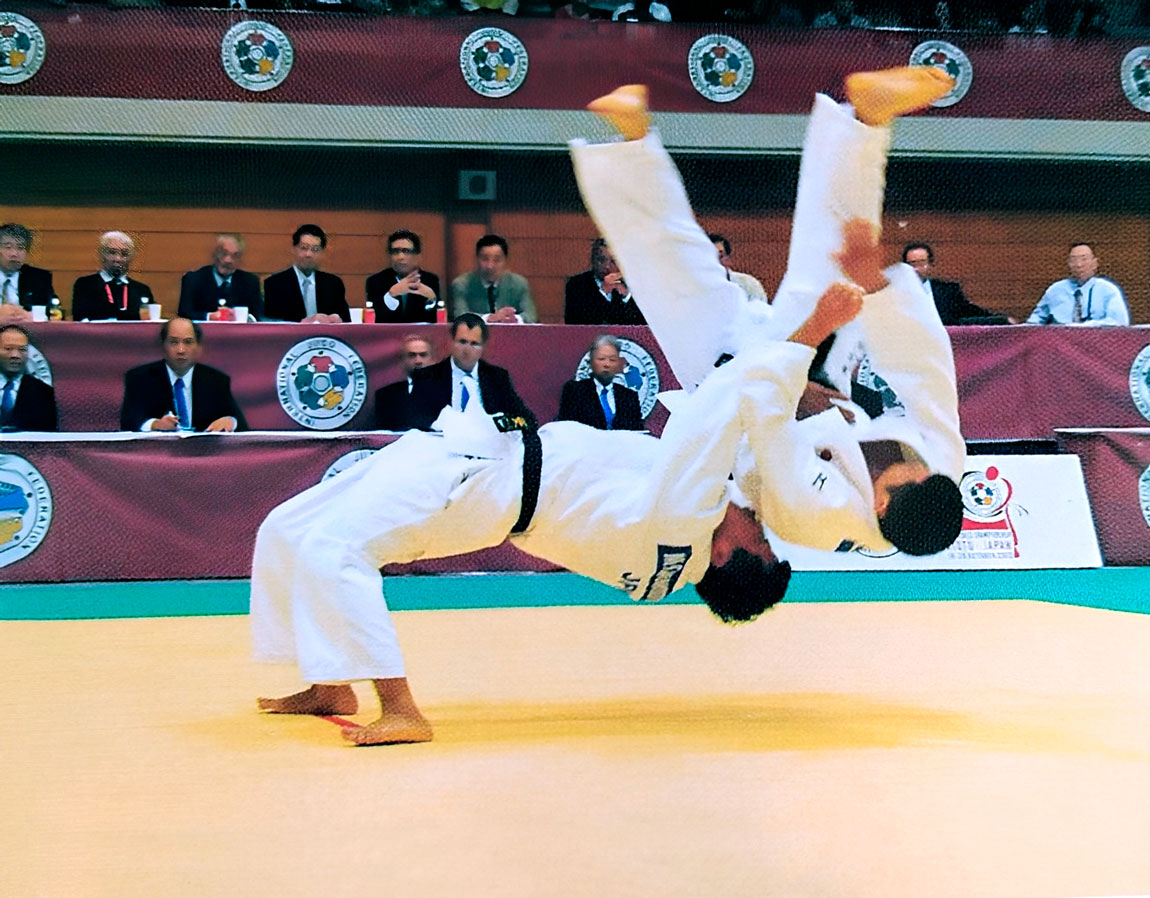 Precise execution illustrates the principle of kuzushi, where the disruption of the opponent’s balance precedes and enhances the effectiveness of the throw © Archive
When analyzing the dynamics of a judo contest, it is essential to first understand the athlete’s mental performance. Judo is not merely an expression of physical strength; it is fundamentally an expression of rationality.
In combat, a judoka must keep the mind free from distractions, sufficiently focused and organized to identify, in the shortest possible time, which techniques are most appropriate to apply against an opponent. This remains true even when competitors are already familiar with one another through observation, scouting and prior study.
This process of recognition through direct contact—the critically important kumi-kata—relies fundamentally on proprioception, that is, sensory information regarding body position, limb orientation, movement amplitude and force production. It also involves visual perception, mental agility and the rapid interpretation of multiple variables present during the encounter.
Researchers and judo specialists have long recognized the importance of establishing control over an opponent through a strong and effective grip, supported by both technical proficiency and gripping strength. The greater a judoka’s ability to identify, before execution, the direction of imbalance and the most suitable technique for a given situation, the greater the likelihood of achieving efficiency in combat.
In judo, this principle is particularly relevant because technical superiority does not arise from the indiscriminate use of force. Rather, it emerges from the ability to act through kumi-kata with proper posture, at the precise moment, in the correct direction and with technical excellence.
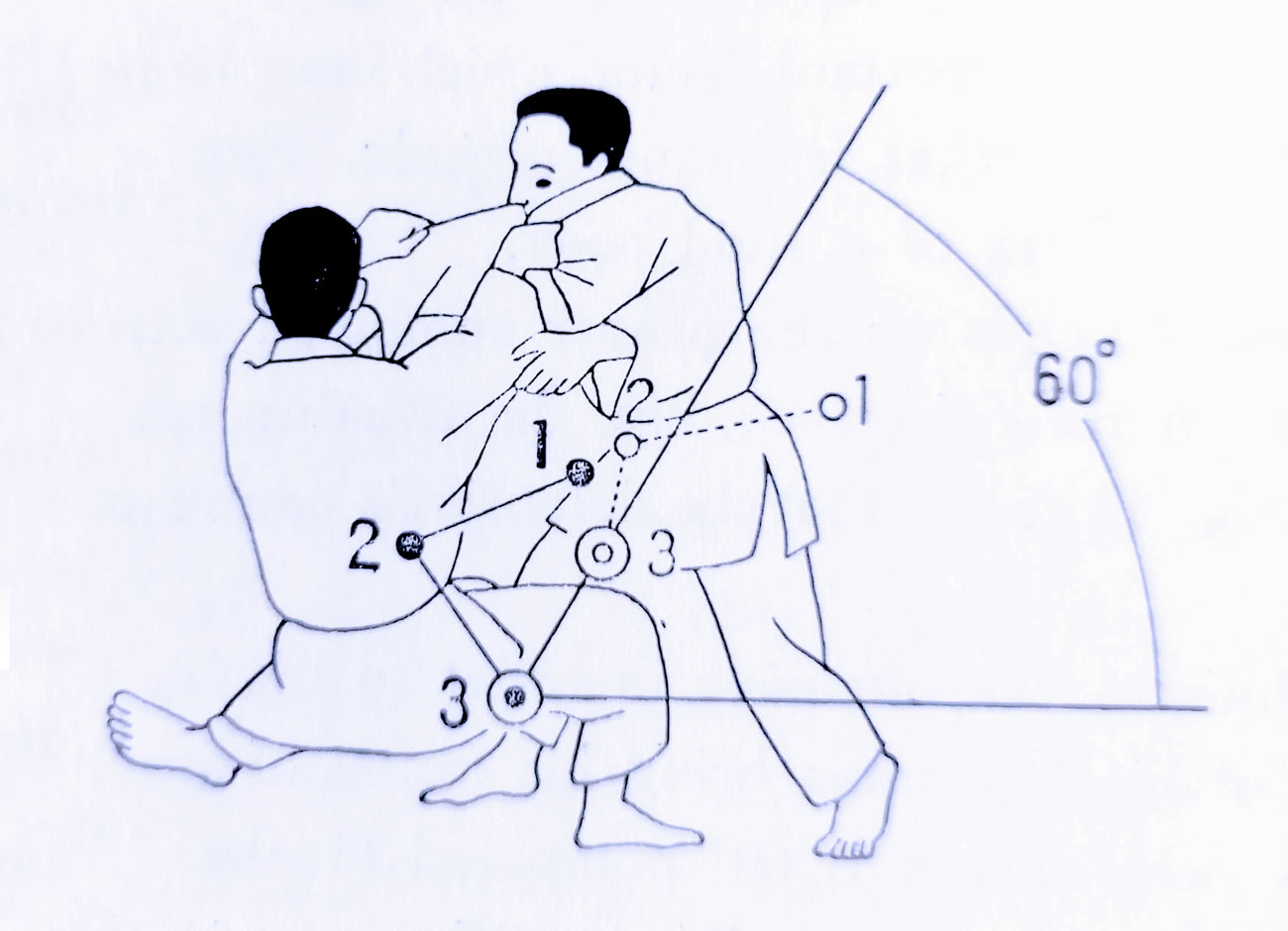
Graphic representation of angular displacement and force application in kuzushi, demonstrating how imbalance is induced through the disruption of the body’s structural alignment © Archive
The instant contact is established and the athlete seeks to execute a preferred tokui-waza, the application of what Donn F. Draeger and Isao Inokuma referred to as “functional strength” becomes indispensable. Today, there is little doubt about the importance of sport-specific strength development in high-performance competition. When properly integrated with technical execution and applied at a precise point of the body, such strength can generate significant mechanical and functional effects.
A correctly executed technique creates imbalance, disrupts postural stability, facilitates technical entry and can temporarily compromise the opponent’s capacity to respond effectively.
Although the opponent simultaneously seeks to counterattack and reorganize defensive actions, there is not always sufficient time for this processing to occur efficiently. In many situations, the speed of technical execution imposes severe limitations on the opponent’s ability to react.
It is within this context that technical superiority becomes evident—not merely through the functional strength employed, but through the ability to position the opponent where one intends, to perceive, decide and act with speed and precision.

From a physics perspective, this process becomes even clearer, as the movements performed during combat can be understood through the mechanical principles governing interacting bodies.
The movement of a body may be described, among other concepts, through torque, generated by a pair of forces and representing the capacity of a force to rotate an object. Torque is calculated as force multiplied by the distance from the point of application—the lever arm. Movement may also be described through linear momentum, which represents resistance to changes in motion and is calculated as the product of mass and velocity.
This means that an opponent’s displacement, technical execution, resistance or recovery are never abstract phenomena. They are concrete expressions of mass in motion.
Experienced judoka understand this in practical terms, even if often intuitively. They know that it is not enough merely to make contact with an opponent’s body; it is necessary to intervene in the dynamics of movement, in the appropriate direction and at a specific leverage point capable of altering balance.
In this regard, we reaffirm the contributions of Archimedes of Syracuse (287–212 BC) and Isaac Newton (1643–1727), whose principles continue to demonstrate the importance of physics and mechanics in judo. Concepts such as action and reaction, equilibrium, levers, inertia, friction, force couples and momentum are all directly relevant to understanding combat.
When an applied force produces displacement, mechanical work is performed; that is, energy is transferred over a given distance and period of time. When this transfer occurs rapidly, power is generated, defined as the rate at which work is performed. Yet technical excellence does not consist simply of maximizing force or power, but of applying them efficiently.
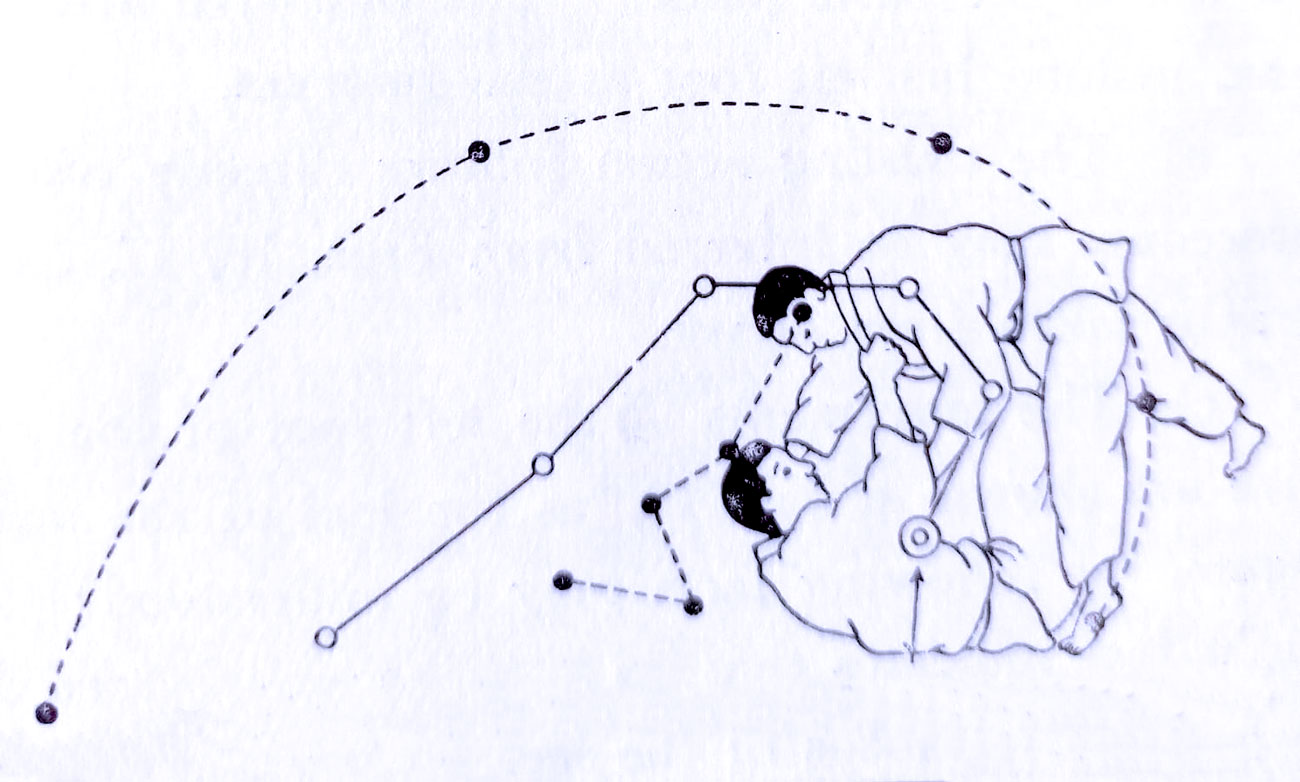
The projected trajectory of the body highlights the continuity of movement following the initial imbalance, reinforcing the mechanical efficiency of the technique © Archive
In this context, force should not be understood merely as brute intensity. Rather, it is an interaction capable of modifying motion or producing deformation. In judo, effectiveness depends less on magnitude alone and more on direction, timing, point of application, synchronization and integration with the movement already taking place.
A well-directed mechanical action, applied at the precise moment and at a specific point, can produce effects far superior to those generated by a powerful but poorly positioned effort.
This is one of the reasons why Jigoro Kano’s judo remains such a rational and elegant expression of the physical intelligence of combat.
The superior judoka does not waste energy—seiryoku-zenyo. Rather, energy is organized, directed and applied with maximum efficiency. Perception becomes timing, timing becomes action and action becomes mechanical effect upon the opponent’s body. This reflects the traditional teachings of sen no sen and saki no saki.

In practical terms, this means that the effectiveness of a technique depends not only on the intensity of the force applied, but also on factors such as direction, precision, coordination, timing, point of application and the athlete’s ability to anticipate events before they unfold.
Technical superiority in judo emerges from the integration of cognition, refined technique, perception, strategy and the efficient application of mechanical principles. This synthesis reflects Jigoro Kano’s enduring vision: maximum efficiency through intelligent action, where mind, body and movement operate as a single system.

14 de outubro de 2026

14 de outubro de 2026

13 de outubro de 2026